Ask a kid to name an animal starting with U and most will get stuck, or say “unicorn”. English has very few native words that begin with U, apart from the many built with un-, under- and up- (this list of U words for kids covers those). So most U animal names come from other languages. Uakari and unau come from Tupi, a language of Brazil. Uguisu is Japanese. Urial comes from Punjabi, and the urial is one of the few animals on this list that lives in India.
Here are twenty real ones, grouped by type of animal.
Mammals
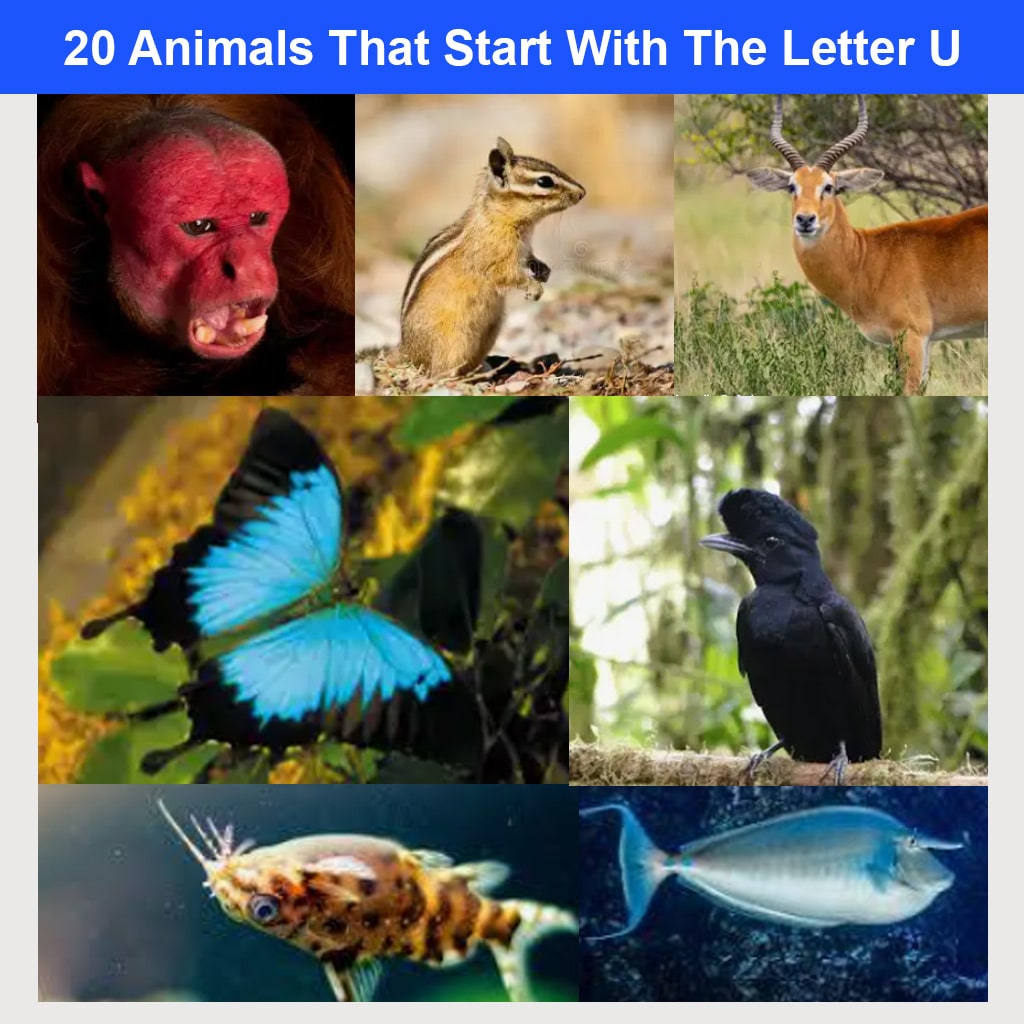
1. Uakari A monkey from the Amazon with a bald head and a bright red face. The red comes from blood vessels just under the skin. A deep red face is a sign of good health, which other uakaris may notice when choosing a mate.
2. Unau “Unau” is another name for the two-toed sloth of Central and South America. Despite the name, it has two toes on its front feet and three on its back feet. It hangs upside down in trees almost all the time, and its body runs so slowly that it may climb down to the ground only about once a week.
3. Urial A wild sheep with large, curling horns, found in the mountains of Central and South Asia, including Ladakh in India. Urials live in small herds and climb steep, rocky slopes with ease.
4. Uganda kob An antelope from the grasslands of East Africa. It’s so closely linked with its home country that it appears on Uganda’s coat of arms. Only the males have horns.
5. Uinta chipmunk A small striped chipmunk from the mountains of the western United States. Like other chipmunks, it stuffs seeds into stretchy cheek pouches and carries them back to its burrow for winter.
6. Utah prairie dog Not a dog at all, but a burrowing rodent from the US state of Utah. Prairie dogs have a complex system of alarm calls, and researchers believe some calls can tell the colony what kind of predator is coming.
7. Unstriped ground squirrel An African squirrel that, as its name says, has no stripes. It lives in dry bush country in East Africa, in burrows with several entrances.
Birds
8. Uguisu A small olive-brown bird from Japan, also called the Japanese bush warbler. Its song is so closely linked with the end of winter that it’s known in Japan as the herald of spring.
9. Umbrellabird A black bird from Central and South American forests. Males have a crest of feathers that opens over their head like an umbrella, and some species have a long feathered flap hanging from the throat.
10. Upland sandpiper Most sandpipers live on beaches and mudflats. This one prefers dry grasslands in North America, and it’s often seen perched on fence posts.
11. Upland goose A goose from southern South America and the Falkland Islands. It feeds mainly on grass. Males are mostly white, and females are a brownish colour.
12. Ural owl A large grey owl from the forests of northern Europe and Asia. It’s known for defending its nest fiercely, even against people who come too close.
13. Uluguru bush-shrike A green and yellow bird found only in a small area of forest in the Uluguru Mountains of Tanzania. Because its home is so small, it is an endangered species.
14. Uganda woodland warbler A tiny green-and-grey songbird of African forests. It moves quickly through the leaves looking for insects and is easier to hear than to see.
In the water
15. Unicornfish A reef fish named for the horn-like bump that some species grow on their foreheads. It has sharp blades near its tail, which it can use to defend itself.
16. Upside-down catfish A small catfish from rivers in central Africa, especially the Congo basin. As its name says, it often swims belly-up, which lets it feed on food from the undersides of leaves and from the water’s surface. Its belly is darker than its back, the opposite of most fish, which helps it blend in while it’s upside down. Asking why an animal is coloured the way it is makes a great science conversation, and it’s the kind of question Bambinos’ live science classes for kids are built around.
17. Urchin Sea urchins are round, spiny animals that live on the sea floor all over the world. They move slowly on hundreds of tiny tube feet and scrape algae off rocks with a mouth on their underside.
Reptiles
18. Uromastyx A lizard from the deserts of North Africa, the Middle East and South Asia, also called the spiny-tailed lizard. When threatened, it hides in a burrow and blocks the entrance with its thick, spiky tail. In the morning it basks in the sun until its body is warm enough to move fast.
Insects
19. Ulysses butterfly A large butterfly from north-eastern Australia with brilliant electric-blue wings on top. The undersides are dull brown, so when it lands and closes its wings it almost disappears.
20. Underwing moth These moths have plain, bark-coloured front wings and bright red, orange or yellow hind wings that are hidden at rest. If a bird attacks, the moth flashes its bright hind wings, which can startle the bird long enough for the moth to escape. Many moths in this group can also hear the high-pitched calls of bats and dodge them.
Spotting a pattern
Look back at the list and you’ll notice that many U animals are named after places: Uganda, the Uinta Mountains, Utah, the Ural Mountains and the Uluguru Mountains. It’s a good conversation starter with older kids: find these places on a map, and see how many other animals are named after where they live, like the Bengal tiger, the Indian rhinoceros or the Arctic fox.
Bambinos’ phonics classes connect letters to words kids are curious about, and the odd ones are often the most memorable. You can book a free class to try one.
About the Author

Ankita Das
AuthorAnkita Das is a professional in the education sector. She has a calm and collected demeanor and a very pleasant and amiable personality. After earning her master's degree in chemistry from the University of Calcutta, she worked as a subject matter expert in chemistry for several companies, including Vaidik Eduservices, Chegg India Pvt. Ltd., and Working Giant. Additionally, she has mentored several students who have achieved success in their respective fields. She came to Bambinos because of her passion for teaching and her love of English, and she wants to make a difference in the company she works for.
LinkedIn Profile ↗